Home
I
am not a professional nor an expert in Cactacea or
Mammillaria taxonomy. Any help with ID and spelling are always welcome. To
up-date my list I've been using many books, journals, catalogs and other
web-sites. It's been helpful, but I have more work to do. We only ship to the
main 48 States. We are offering 72+ hour heat packs for $4.00 each.
Please read the front page for ordering information.
Coryphantha
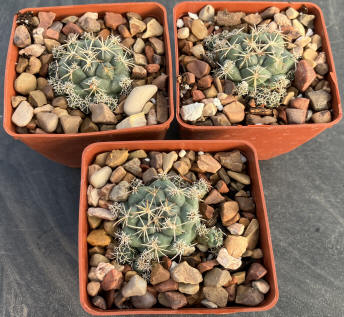 Coryphantha elephantidens sm - Not real sure about
the ID of this plant. It came to me a very long time ago with this name. Is
a large, depressed-globular cactus, simple or occasionally clumping and
group-forming. C.
elephantidens usually
has pink flowers but they can sometimes be yellow. This species comprises three
subspecies - the typical form, subsp. bumamma (Ehrenb.)
Dicht & A.Lüthy, and subsp. greenwoodii (Bravo)
Dicht & A.Lüthy. The epithet 'elephantidens' comes
from Latin and means 'elephant
tooth' and
describes the fang-like spines of this species. Stems simple, flattened globular
to subglobose, up to 14(-19) cm in diameter and 14 cm high, glossy dark green,
subglaucous. Tubercles are very large, somewhat flattened, 20-30 (60) mm wide,
obtuse, rounded on top, pentaedrical at the base, 4 to 5 cm wide, always broader
than rounded, without glands, the tubercles axil is densely woolly. The
tubercles are capped with a 5-8 of stout reflexed radial spines, spreading,
somewhat unequal, 18-26 mm long, strong, subulate, curved, never porrect, but
adpressed to the body, when young brownish with yellowish bases, black at apex.
Central spines are absent. Flowers are sweet smelling large 6 to 11 cm whitish
broad, perianth-segments numerous, narrowly oblong, apiculate rose-colored to
purple pink or white with a reddish throat and reddish median strip, (rarely
yellow). Blooming season late summer to autumn. Mexico. Offsets from our old
mother plant. Growing in 2.75"
pots. 13 in stock @ $10.00 each.
Coryphantha elephantidens sm - Not real sure about
the ID of this plant. It came to me a very long time ago with this name. Is
a large, depressed-globular cactus, simple or occasionally clumping and
group-forming. C.
elephantidens usually
has pink flowers but they can sometimes be yellow. This species comprises three
subspecies - the typical form, subsp. bumamma (Ehrenb.)
Dicht & A.Lüthy, and subsp. greenwoodii (Bravo)
Dicht & A.Lüthy. The epithet 'elephantidens' comes
from Latin and means 'elephant
tooth' and
describes the fang-like spines of this species. Stems simple, flattened globular
to subglobose, up to 14(-19) cm in diameter and 14 cm high, glossy dark green,
subglaucous. Tubercles are very large, somewhat flattened, 20-30 (60) mm wide,
obtuse, rounded on top, pentaedrical at the base, 4 to 5 cm wide, always broader
than rounded, without glands, the tubercles axil is densely woolly. The
tubercles are capped with a 5-8 of stout reflexed radial spines, spreading,
somewhat unequal, 18-26 mm long, strong, subulate, curved, never porrect, but
adpressed to the body, when young brownish with yellowish bases, black at apex.
Central spines are absent. Flowers are sweet smelling large 6 to 11 cm whitish
broad, perianth-segments numerous, narrowly oblong, apiculate rose-colored to
purple pink or white with a reddish throat and reddish median strip, (rarely
yellow). Blooming season late summer to autumn. Mexico. Offsets from our old
mother plant. Growing in 2.75"
pots. 13 in stock @ $10.00 each.
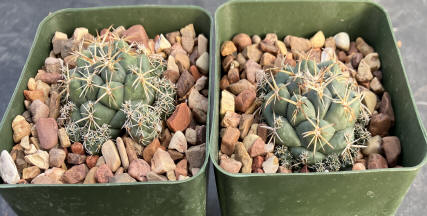 Coryphantha elephantidens m - Not real sure about
the ID of this plant. It came to me a very long time ago with this name. Is
a large, depressed-globular cactus, simple or occasionally clumping and
group-forming. C.
elephantidens usually
has pink flowers but they can sometimes be yellow. This species comprises three
subspecies - the typical form, subsp. bumamma (Ehrenb.)
Dicht & A.Lüthy, and subsp. greenwoodii (Bravo)
Dicht & A.Lüthy. The epithet 'elephantidens' comes
from Latin and means 'elephant
tooth' and
describes the fang-like spines of this species. Stems simple, flattened globular
to subglobose, up to 14(-19) cm in diameter and 14 cm high, glossy dark green,
subglaucous. Tubercles are very large, somewhat flattened, 20-30 (60) mm wide,
obtuse, rounded on top, pentaedrical at the base, 4 to 5 cm wide, always broader
than rounded, without glands, the tubercles axil is densely woolly. The
tubercles are capped with a 5-8 of stout reflexed radial spines, spreading,
somewhat unequal, 18-26 mm long, strong, subulate, curved, never porrect, but
adpressed to the body, when young brownish with yellowish bases, black at apex.
Central spines are absent. Flowers are sweet smelling large 6 to 11 cm whitish
broad, perianth-segments numerous, narrowly oblong, apiculate rose-colored to
purple pink or white with a reddish throat and reddish median strip, (rarely
yellow). Blooming season late summer to autumn. Mexico. Offsets from our old
mother plant. Growing in 3 1/2"
pots. 2 in stock @ $15.00 each.
Coryphantha elephantidens m - Not real sure about
the ID of this plant. It came to me a very long time ago with this name. Is
a large, depressed-globular cactus, simple or occasionally clumping and
group-forming. C.
elephantidens usually
has pink flowers but they can sometimes be yellow. This species comprises three
subspecies - the typical form, subsp. bumamma (Ehrenb.)
Dicht & A.Lüthy, and subsp. greenwoodii (Bravo)
Dicht & A.Lüthy. The epithet 'elephantidens' comes
from Latin and means 'elephant
tooth' and
describes the fang-like spines of this species. Stems simple, flattened globular
to subglobose, up to 14(-19) cm in diameter and 14 cm high, glossy dark green,
subglaucous. Tubercles are very large, somewhat flattened, 20-30 (60) mm wide,
obtuse, rounded on top, pentaedrical at the base, 4 to 5 cm wide, always broader
than rounded, without glands, the tubercles axil is densely woolly. The
tubercles are capped with a 5-8 of stout reflexed radial spines, spreading,
somewhat unequal, 18-26 mm long, strong, subulate, curved, never porrect, but
adpressed to the body, when young brownish with yellowish bases, black at apex.
Central spines are absent. Flowers are sweet smelling large 6 to 11 cm whitish
broad, perianth-segments numerous, narrowly oblong, apiculate rose-colored to
purple pink or white with a reddish throat and reddish median strip, (rarely
yellow). Blooming season late summer to autumn. Mexico. Offsets from our old
mother plant. Growing in 3 1/2"
pots. 2 in stock @ $15.00 each.
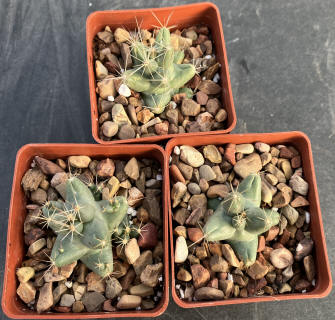
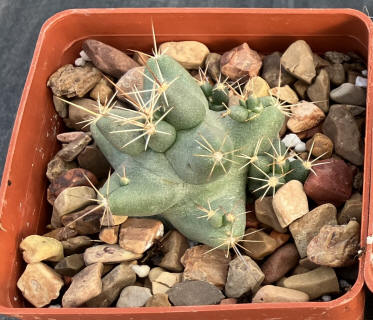 Coryphantha macromeris sm - the plants profusely
branched with long projecting spines, ultimately forming low mats or hemispheric
mounds to 100 cm diameter. Coryphantha macromeris comprises two subspecies - the
typical form and subsp. runyonii (Britton & Rose) N.P.Taylor. Stems are
noticeably tuberculate, hemispheric to short cylindrical, sometimes obscured by
profusion of immature branches, 4-12 cm; tubercles unusually large 15-25 mm and
grooved only on the upper half, flaccid or flabby; areolar glands seasonally
conspicuous. Roots are deep succulent taproot often massive and large. Spines
are weakly appressed or projecting, slightly curved, often flexible. Radial 9-15
per areole, white, grey, tan, or brown, 15-25 mm long; subcentral spines 2-3 in
adaxial part of areole; central spines 3-8 per areole, pale grey to black,
abaxial central spine porrect or descending. Flowers are apical or nearly so at
mid-level of tubercle, outer tepals heavily fringed; flower bright rose-pink or
magenta, often with darker midstripes and paler margins.
New Mexico, Texas, USA and Mexico. Growing in 2,75" pots.
12 in stock @ $13.00 each.
Coryphantha macromeris sm - the plants profusely
branched with long projecting spines, ultimately forming low mats or hemispheric
mounds to 100 cm diameter. Coryphantha macromeris comprises two subspecies - the
typical form and subsp. runyonii (Britton & Rose) N.P.Taylor. Stems are
noticeably tuberculate, hemispheric to short cylindrical, sometimes obscured by
profusion of immature branches, 4-12 cm; tubercles unusually large 15-25 mm and
grooved only on the upper half, flaccid or flabby; areolar glands seasonally
conspicuous. Roots are deep succulent taproot often massive and large. Spines
are weakly appressed or projecting, slightly curved, often flexible. Radial 9-15
per areole, white, grey, tan, or brown, 15-25 mm long; subcentral spines 2-3 in
adaxial part of areole; central spines 3-8 per areole, pale grey to black,
abaxial central spine porrect or descending. Flowers are apical or nearly so at
mid-level of tubercle, outer tepals heavily fringed; flower bright rose-pink or
magenta, often with darker midstripes and paler margins.
New Mexico, Texas, USA and Mexico. Growing in 2,75" pots.
12 in stock @ $13.00 each.
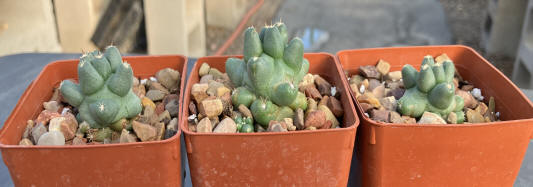
 Coryphantha sunderlandii sm - Propagated from our
old collection plants. Clumping with tiny star spines. Sometime no spines at
all. Pink flowers. A note from her Daughter Sue 01-06-24. My mother (Mrs. Viola
Sunderland) is the one who discovered the Coryphantha sunderlandii. She is still
living at age 90 and has two of these plants on her nursing home windowsill.
Found on one ranch in South Texas. These are cuttings from one of our old mother
plants. Growing in 2.75" pots. 31 in stock @ $13.00 each.
Coryphantha sunderlandii sm - Propagated from our
old collection plants. Clumping with tiny star spines. Sometime no spines at
all. Pink flowers. A note from her Daughter Sue 01-06-24. My mother (Mrs. Viola
Sunderland) is the one who discovered the Coryphantha sunderlandii. She is still
living at age 90 and has two of these plants on her nursing home windowsill.
Found on one ranch in South Texas. These are cuttings from one of our old mother
plants. Growing in 2.75" pots. 31 in stock @ $13.00 each.
Epithelantha
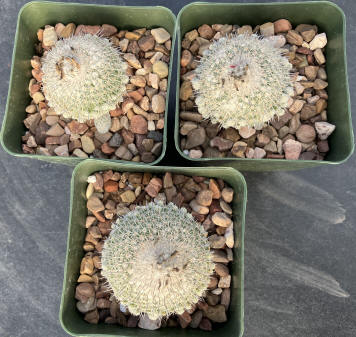
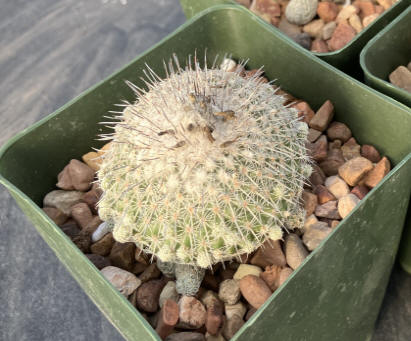 Epithelantha micromeris ssp unguispina m - This one is similar to the type
species but usually a little larger and free clustering with a distinct,
slightly long projecting black-tipped central spines, also the pink flowers are
larger than the others. Seed grown. Mexico. Growing in 3 1/2" pots. 19 in stock
@ $30.00 each.
Epithelantha micromeris ssp unguispina m - This one is similar to the type
species but usually a little larger and free clustering with a distinct,
slightly long projecting black-tipped central spines, also the pink flowers are
larger than the others. Seed grown. Mexico. Growing in 3 1/2" pots. 19 in stock
@ $30.00 each.
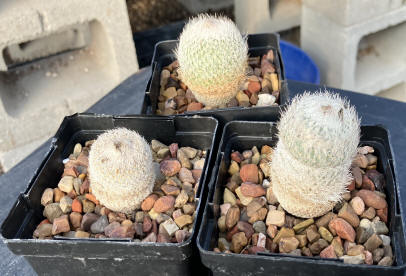 Epithelantha micromeris m - These are a mix of Epithelantha micromeris grown
from seed. Growing in 3 1/2" pots. 4 in stock @ $18.00 each.
Epithelantha micromeris m - These are a mix of Epithelantha micromeris grown
from seed. Growing in 3 1/2" pots. 4 in stock @ $18.00 each.
Escobaria
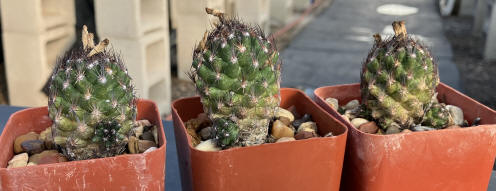 Escobaria hesteri black spine form sm - Sometime listed as Coryphantha heateri.
It's a dwarf cactus will offsetting to form clusters with age. Flowers near the
top of the stems, gorgeous deep rose-purple to magenta with a paler throat.
Southwestern Texas. Propagated from our old large collection plants. Growing in
2.75" pots. 9 in stock @ $10.00 each..
Escobaria hesteri black spine form sm - Sometime listed as Coryphantha heateri.
It's a dwarf cactus will offsetting to form clusters with age. Flowers near the
top of the stems, gorgeous deep rose-purple to magenta with a paler throat.
Southwestern Texas. Propagated from our old large collection plants. Growing in
2.75" pots. 9 in stock @ $10.00 each..
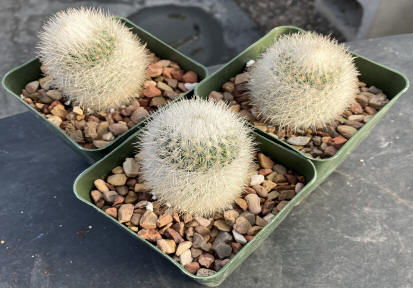 Escobaria laredoi m -
Is a very showy cactus species with stems densely covered with pure white spines
and contrasting purple flowers in spring. It is a low growing
perennial stem-succulent solitary or many-stemmed, often forming large, compact
clusters. Stems are
upright, spherical to egg shaped or club shaped, 4-4,5 cm across. Flowers are
small, bright lavender to magenta. Mexico. Growing in 3 1/2" pots. 5 in stock @
$15.00 each.
Escobaria laredoi m -
Is a very showy cactus species with stems densely covered with pure white spines
and contrasting purple flowers in spring. It is a low growing
perennial stem-succulent solitary or many-stemmed, often forming large, compact
clusters. Stems are
upright, spherical to egg shaped or club shaped, 4-4,5 cm across. Flowers are
small, bright lavender to magenta. Mexico. Growing in 3 1/2" pots. 5 in stock @
$15.00 each.
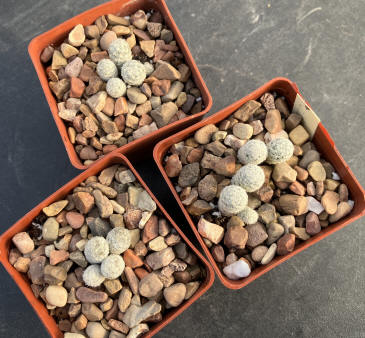 Escobaria sneedii ssp. leei sm -
This species is listed as threatened, but it is quite frequent in its very small
area of distribution. It is popular with collectors and has been subject to
commercial collecting in the past, but is now propagated commercially on a large
scale and is readily available. Grows in dense clusters with as many as 100 or
more stems in a clump. Flowers are brownish-pink in early April-May. New Mexico,
Eddy County, Guadalupe Mountains in the USA. Grown from offsets from our old
mother plants. Growing in 2.75" 5 in stock @ $10.00 each.
Escobaria sneedii ssp. leei sm -
This species is listed as threatened, but it is quite frequent in its very small
area of distribution. It is popular with collectors and has been subject to
commercial collecting in the past, but is now propagated commercially on a large
scale and is readily available. Grows in dense clusters with as many as 100 or
more stems in a clump. Flowers are brownish-pink in early April-May. New Mexico,
Eddy County, Guadalupe Mountains in the USA. Grown from offsets from our old
mother plants. Growing in 2.75" 5 in stock @ $10.00 each.
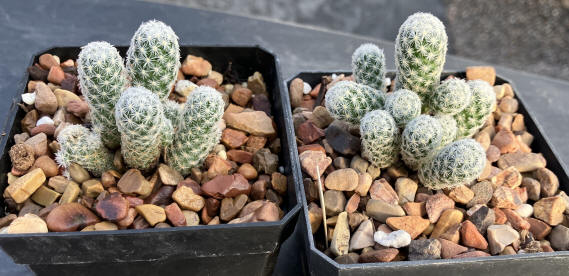 Escobaria sneedii ssp. leei m -
This species is listed as threatened, but it is quite frequent in its very small
area of distribution. It is popular with collectors and has been subject to
commercial collecting in the past, but is now propagated commercially on a large
scale and is readily available. Grows in dense clusters with as many as 100 or
more stems in a clump. Flowers are brownish-pink in early April-May. New Mexico,
Eddy County, Guadalupe Mountains in the USA. Grown from offsets from our old
mother plants. Growing in 3 1/2" 2 in stock @ $15.00 each.
Escobaria sneedii ssp. leei m -
This species is listed as threatened, but it is quite frequent in its very small
area of distribution. It is popular with collectors and has been subject to
commercial collecting in the past, but is now propagated commercially on a large
scale and is readily available. Grows in dense clusters with as many as 100 or
more stems in a clump. Flowers are brownish-pink in early April-May. New Mexico,
Eddy County, Guadalupe Mountains in the USA. Grown from offsets from our old
mother plants. Growing in 3 1/2" 2 in stock @ $15.00 each.
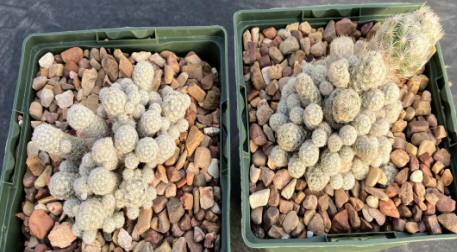
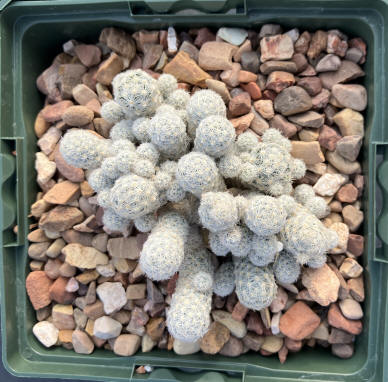 Escobaria sneedii ssp. leei lg -
This species is listed as threatened, but it is quite frequent in its very small
area of distribution. It is popular with collectors and has been subject to
commercial collecting in the past, but is now propagated commercially on a large
scale and is readily available. Grows in dense clusters with as many as 100 or
more stems in a clump. Flowers are brownish-pink in early April-May. New Mexico,
Eddy County, Guadalupe Mountains in the USA. Grown from offsets from our old
mother plants. Growing in 4 1/2" 2 in stock ) @ $18.00 each.
BOTH SOLD
Escobaria sneedii ssp. leei lg -
This species is listed as threatened, but it is quite frequent in its very small
area of distribution. It is popular with collectors and has been subject to
commercial collecting in the past, but is now propagated commercially on a large
scale and is readily available. Grows in dense clusters with as many as 100 or
more stems in a clump. Flowers are brownish-pink in early April-May. New Mexico,
Eddy County, Guadalupe Mountains in the USA. Grown from offsets from our old
mother plants. Growing in 4 1/2" 2 in stock ) @ $18.00 each.
BOTH SOLD
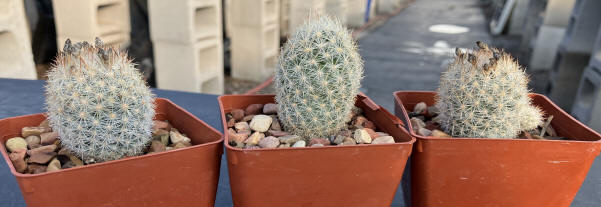 Escobaria vivipara X Escobaria sneedii sm - Looks like a large headed Escobaria
with a slit pinkish-brown color to the spines tips. Clumping with pink flowers.
Propagated from a very old large collection plant. Nursery origin. Propagated
from our large collection plant. Growing in 2.75"pots. 7 in stock a @ $13.00
each.
Escobaria vivipara X Escobaria sneedii sm - Looks like a large headed Escobaria
with a slit pinkish-brown color to the spines tips. Clumping with pink flowers.
Propagated from a very old large collection plant. Nursery origin. Propagated
from our large collection plant. Growing in 2.75"pots. 7 in stock a @ $13.00
each.
Home