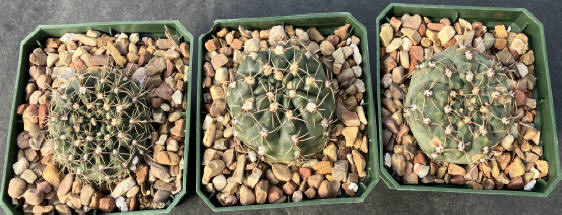
 Gymnocalycium amerhauseri lg - Flowers are pink with dark pink
throats. Clumping. Argentina. Seed grown. Growing in 4 1/2" pots. 4 in stock @ $15.00 each.
Gymnocalycium amerhauseri lg - Flowers are pink with dark pink
throats. Clumping. Argentina. Seed grown. Growing in 4 1/2" pots. 4 in stock @ $15.00 each.
I am not a professional nor an expert in these plant groups taxonomy. Any help with ID and spelling are always welcome. Photos are for reference only. To up-date my list I've been using many books, journals, catalogs and other web-sites. It's been helpful, but I have more work to do. I only ship to the main 48 States. I do ship in the winter months. I can add 72+ hour heat packs for $4.00 each. No international shipping. Please read the front page for ordering information.
Note: These photos where taken January, 2025.
Gymnocalycium
Gymnocalycium amerhauseri lg - Flowers are pink with dark pink
throats. Clumping. Argentina. Seed grown. Growing in 4 1/2" pots. 4 in stock @ $15.00 each.
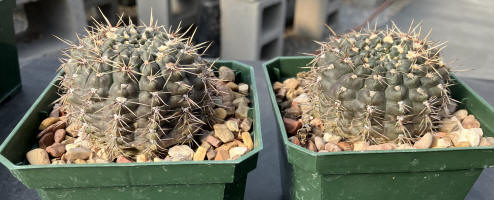 Gymnocalycium andreae lg - Flowers are light yellow. Clumping.
Argentina. Seed grown. Growing in 4 1/2" pots. 2 @ $15.00 each.
Gymnocalycium andreae lg - Flowers are light yellow. Clumping.
Argentina. Seed grown. Growing in 4 1/2" pots. 2 @ $15.00 each.
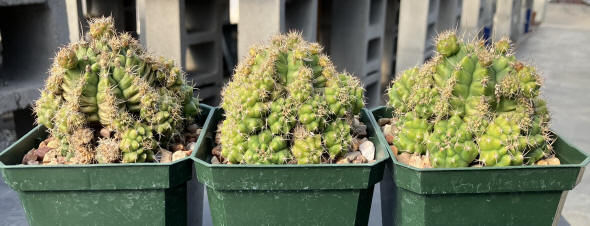
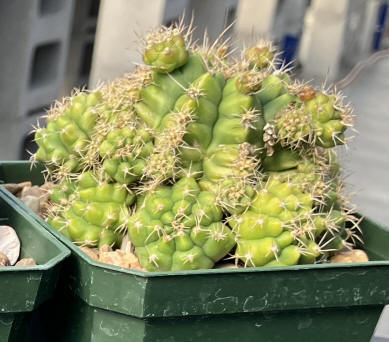 Gymnocalyicum anisitsii ssp. damsii lg - A plant with many offsets and white
flowers. Argentina.
These are offsets from our stock plant. Growing in 4 1/2" pots. 3 in stock @
$15.00 each.
Gymnocalyicum anisitsii ssp. damsii lg - A plant with many offsets and white
flowers. Argentina.
These are offsets from our stock plant. Growing in 4 1/2" pots. 3 in stock @
$15.00 each.
 Gymnocalycium
bodenbenderianum m - Also found as Gymnocalycium psuedorogonesei.
It's
a low-growing, flattish cactus species characterized by brownish-green stems and
white flowers often pink flushed. It is a geophyte stem succulent plant usually
solitary and barely rising above ground level with a swollen underground root
system.
Argentina.
Growing in 3 1/2" pots. 2 in stock @ $15.00
each.
Gymnocalycium
bodenbenderianum m - Also found as Gymnocalycium psuedorogonesei.
It's
a low-growing, flattish cactus species characterized by brownish-green stems and
white flowers often pink flushed. It is a geophyte stem succulent plant usually
solitary and barely rising above ground level with a swollen underground root
system.
Argentina.
Growing in 3 1/2" pots. 2 in stock @ $15.00
each.
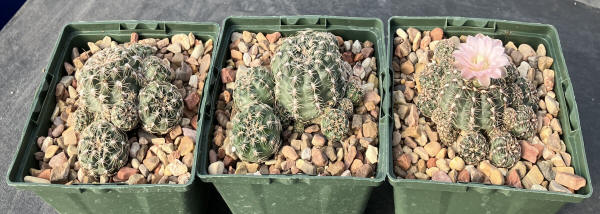
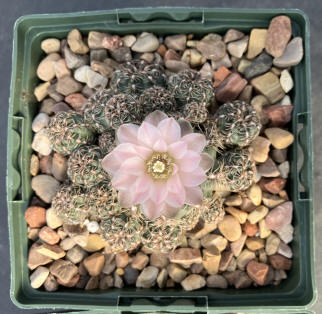 Gymnocalycium bruchii lg - Is
a miniature clumping succulent that clusters when small. This species is very
variable and has received many names. Bell to funnel-shaped flowers with an
unusual shade of lavender-white in early spring, followed by green fruits.
This is one of the most cold-tolerant South American species. It can grow
outdoors, and is hardy to 5F or less.
Argentina. Offsets from our old mother plant. Growing in 4 1/2" pots. 9 in stock @ $18.00 each.
Gymnocalycium bruchii lg - Is
a miniature clumping succulent that clusters when small. This species is very
variable and has received many names. Bell to funnel-shaped flowers with an
unusual shade of lavender-white in early spring, followed by green fruits.
This is one of the most cold-tolerant South American species. It can grow
outdoors, and is hardy to 5F or less.
Argentina. Offsets from our old mother plant. Growing in 4 1/2" pots. 9 in stock @ $18.00 each.
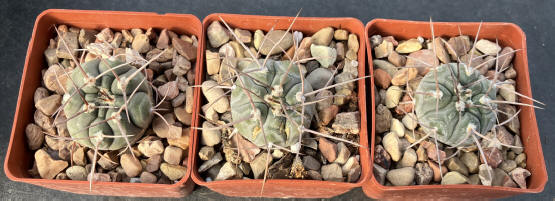 Gymnocalycium castellarosii ssp. bozsingianum P205 sm
- Refers to a specific collection number (P205) of the cactus subspecies Gymnocalycium
castellanosii var. bozsingianum,
a solitary, summer-growing
Gymnocalycium known for its heavy, backward-bent
spines and grey-green body, originating from
Chepes Viejo, La Rioja, Argentina.
The P205 number identifies seeds or plants sourced from a specific location and
collector, often from Bruno Knutti or Christian Hefti, indicating a desirable
strain with strong spines. Pink
flowers. Growing in 2.75" pots. 12 in stock @ $15.00 each.
Gymnocalycium castellarosii ssp. bozsingianum P205 sm
- Refers to a specific collection number (P205) of the cactus subspecies Gymnocalycium
castellanosii var. bozsingianum,
a solitary, summer-growing
Gymnocalycium known for its heavy, backward-bent
spines and grey-green body, originating from
Chepes Viejo, La Rioja, Argentina.
The P205 number identifies seeds or plants sourced from a specific location and
collector, often from Bruno Knutti or Christian Hefti, indicating a desirable
strain with strong spines. Pink
flowers. Growing in 2.75" pots. 12 in stock @ $15.00 each.
 Gymnocalycium
chiquitanum lg - Propagated from our old large variegated plant. These are some
of the green one that may have a little variegation. Clumping. Flowers pink with
dark throat. Growing in a 4 1/2" pot. $15.00 each.
Gymnocalycium
chiquitanum lg - Propagated from our old large variegated plant. These are some
of the green one that may have a little variegation. Clumping. Flowers pink with
dark throat. Growing in a 4 1/2" pot. $15.00 each.
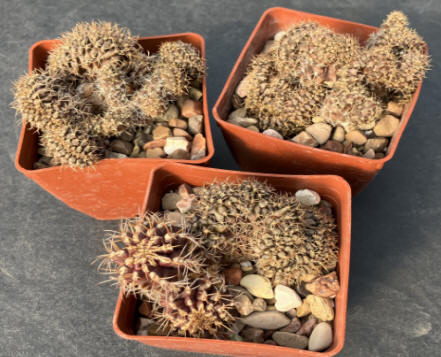
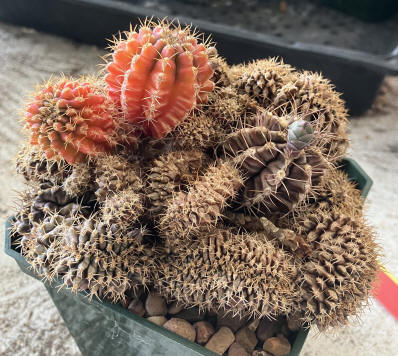 Gymnocalycium damsii monstrose grest sm -
This cactus exhibits both "monstrose" (random, lumpy, irregular growth points)
and "crested" (fan-shaped or serpentine growth along an elongated line)
mutations. This results in a one-of-a-kind, sculptural appearance for each
specimen, making it highly prized by collectors.
Coloration of the stem is typically green but can develop striking
reddish or brownish hues when exposed to sufficient sunlight or under stress
conditions.
Spines are generally short (up to 12 mm), whitish with darker tips, and often
sparse or absent in some parts due to the monstrous form.
The parent species G.
damsii produces funnel-shaped flowers, typically white to
light pinkish or greenish, and is a very free-flowering cactus. Crested forms
may have difficulty flowering or produce unusual crested flowers. These
are cutting from one of our old mother. The photo with orange stem is one of our
mother plants. Growing in 2.75" pots. 20 in stock @ $15.00 each.
Gymnocalycium damsii monstrose grest sm -
This cactus exhibits both "monstrose" (random, lumpy, irregular growth points)
and "crested" (fan-shaped or serpentine growth along an elongated line)
mutations. This results in a one-of-a-kind, sculptural appearance for each
specimen, making it highly prized by collectors.
Coloration of the stem is typically green but can develop striking
reddish or brownish hues when exposed to sufficient sunlight or under stress
conditions.
Spines are generally short (up to 12 mm), whitish with darker tips, and often
sparse or absent in some parts due to the monstrous form.
The parent species G.
damsii produces funnel-shaped flowers, typically white to
light pinkish or greenish, and is a very free-flowering cactus. Crested forms
may have difficulty flowering or produce unusual crested flowers. These
are cutting from one of our old mother. The photo with orange stem is one of our
mother plants. Growing in 2.75" pots. 20 in stock @ $15.00 each.
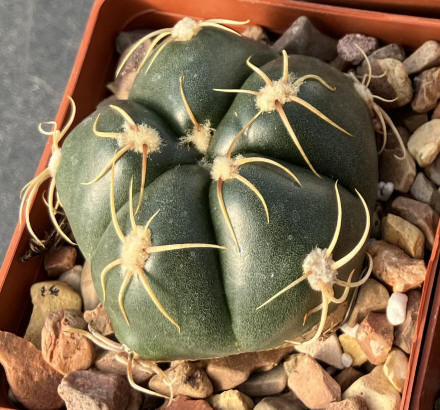 Gymnocalycium denudatum sm -
This species has nearly armless spines flattened against body, looking like a
bunch of white spiders crawling on a cactus. Flowers are are a
pale rose-color. Brazil, Argentina, Paraguay and Uruguay. Offsets from
our old mother plant. Growing in 2.75" pots. 5 in stock @ $15.00 each.
Gymnocalycium denudatum sm -
This species has nearly armless spines flattened against body, looking like a
bunch of white spiders crawling on a cactus. Flowers are are a
pale rose-color. Brazil, Argentina, Paraguay and Uruguay. Offsets from
our old mother plant. Growing in 2.75" pots. 5 in stock @ $15.00 each.
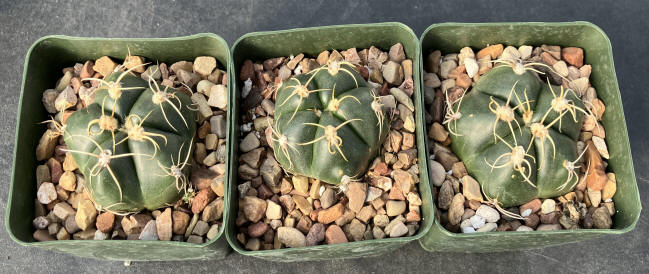
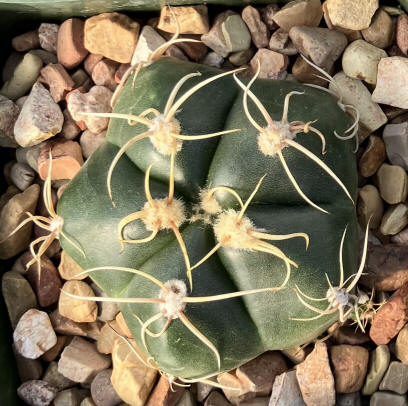 Gymnocalycium denudatum m -
This species has nearly armless spines flattened against body, looking like a
bunch of white spiders crawling on a cactus. Flowers are are a
pale rose-color. Brazil, Argentina, Paraguay and Uruguay. Offsets from
our old mother plant. Growing in 3 1/2" pots. 3 in stock @ $18.00 each.
Gymnocalycium denudatum m -
This species has nearly armless spines flattened against body, looking like a
bunch of white spiders crawling on a cactus. Flowers are are a
pale rose-color. Brazil, Argentina, Paraguay and Uruguay. Offsets from
our old mother plant. Growing in 3 1/2" pots. 3 in stock @ $18.00 each.
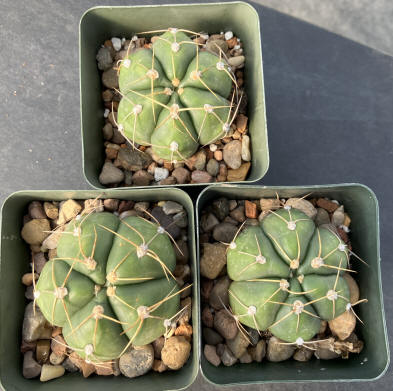 Gymnocalycium horstii ssp. buenekeri m - These are normal cuttings off our old crest mother
plant. Slow to clump. Flowers can be white, pale pink, pink or pale purplish.
Uruguay, Paraguay, Brazil and Argentina. Growing in 3 1/2" pots. 4 in stock @
$15.00 each.
Gymnocalycium horstii ssp. buenekeri m - These are normal cuttings off our old crest mother
plant. Slow to clump. Flowers can be white, pale pink, pink or pale purplish.
Uruguay, Paraguay, Brazil and Argentina. Growing in 3 1/2" pots. 4 in stock @
$15.00 each.
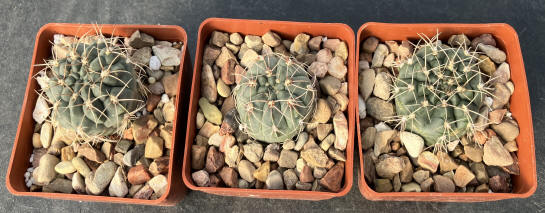
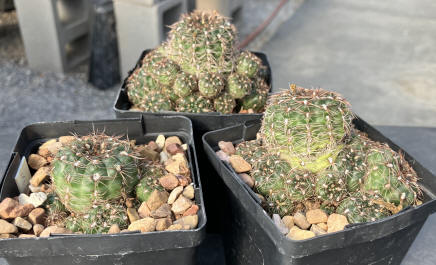
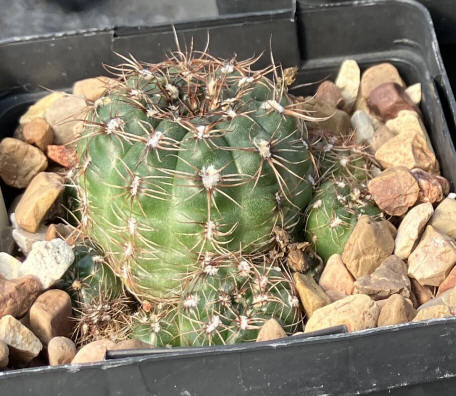 Gymnocalycium
mesoptamicum m - Propagated from our old large collection plant. Small clumping
plants. Heavy bloomers. White flowers. Argentina. Growing in 3 1/2" pots. 3 @
$15.00 each.
Gymnocalycium
mesoptamicum m - Propagated from our old large collection plant. Small clumping
plants. Heavy bloomers. White flowers. Argentina. Growing in 3 1/2" pots. 3 @
$15.00 each.
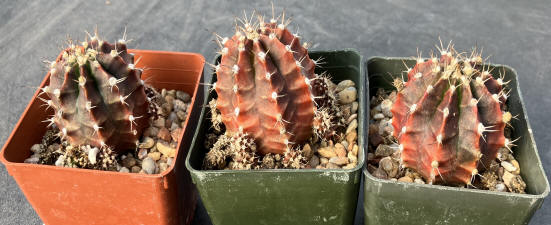 Gymnocalycium mihanovichii "Nishikii" sm - Comprises
a large group of popular mutants, characterized by variegated only partially
de-colored stems. The more or less colored bodies have parts, strips, or sectors
with few chlorophyll or even no chlorophyll at all, are red but also orange,
dark purplish, yellow or even white) with normal colored parts. Some of this
colorful plants (those with some chlorophyll) are able to grow on their own
roots and are very beautiful and priced by collectors. Pale-pink to
purplish-pink flowers. Offsets from our old grafted mother plants.
Growing in 2.75" pots. 5 in stock @ $15.00 each.
Gymnocalycium mihanovichii "Nishikii" sm - Comprises
a large group of popular mutants, characterized by variegated only partially
de-colored stems. The more or less colored bodies have parts, strips, or sectors
with few chlorophyll or even no chlorophyll at all, are red but also orange,
dark purplish, yellow or even white) with normal colored parts. Some of this
colorful plants (those with some chlorophyll) are able to grow on their own
roots and are very beautiful and priced by collectors. Pale-pink to
purplish-pink flowers. Offsets from our old grafted mother plants.
Growing in 2.75" pots. 5 in stock @ $15.00 each.
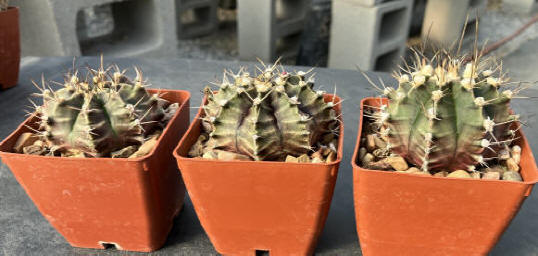 Gymnocalycium mihanovichii ssp. stenoplurum sm -
It is a small solitary cactus with banded body that has perianth-segments
pinkish-red with white margins (but also pale pink or almost pure white).
Pale-pink to purplish-pink flowers. This species is sometimes combined with Gymnocalycium
mihanovichii,
and sometimes kept as a separate species. Paraguay. Seed grown.
Growing in 2.75" pots. 34 in stock @ $13.00 each.
Gymnocalycium mihanovichii ssp. stenoplurum sm -
It is a small solitary cactus with banded body that has perianth-segments
pinkish-red with white margins (but also pale pink or almost pure white).
Pale-pink to purplish-pink flowers. This species is sometimes combined with Gymnocalycium
mihanovichii,
and sometimes kept as a separate species. Paraguay. Seed grown.
Growing in 2.75" pots. 34 in stock @ $13.00 each.
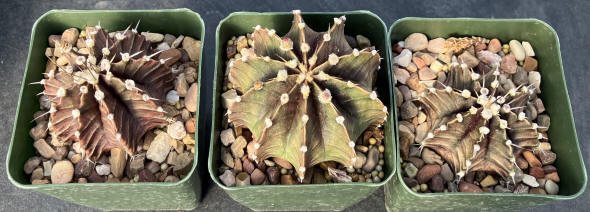 Gymnocalycium mihanovichii ssp. stenoplurum sm -
It is a small solitary cactus with banded body that has perianth-segments
pinkish-red with white margins (but also pale pink or almost pure white).
Pale-pink to purplish-pink flowers. This species is sometimes combined with Gymnocalycium
mihanovichii,
and sometimes kept as a separate species. Paraguay. Seed grown.
Growing in 3 1/2" pots. 3 in stock @ $20.00 each.
Gymnocalycium mihanovichii ssp. stenoplurum sm -
It is a small solitary cactus with banded body that has perianth-segments
pinkish-red with white margins (but also pale pink or almost pure white).
Pale-pink to purplish-pink flowers. This species is sometimes combined with Gymnocalycium
mihanovichii,
and sometimes kept as a separate species. Paraguay. Seed grown.
Growing in 3 1/2" pots. 3 in stock @ $20.00 each.
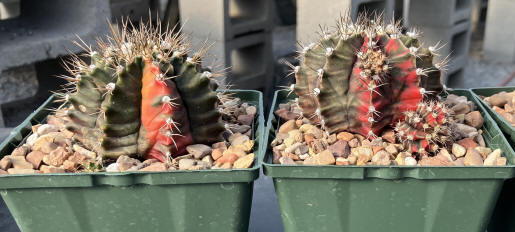 Gymnocalycium mihanovichii variegata "Black Widow" lg - Seed grown. Growing in 4
1/2" pots. 2 in stock @ $30.00 each.
Gymnocalycium mihanovichii variegata "Black Widow" lg - Seed grown. Growing in 4
1/2" pots. 2 in stock @ $30.00 each.
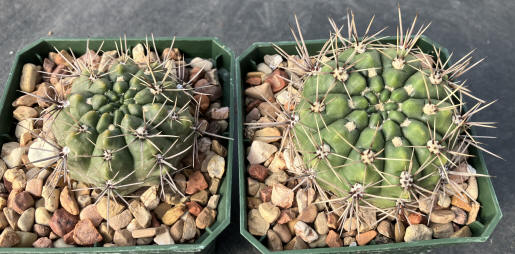
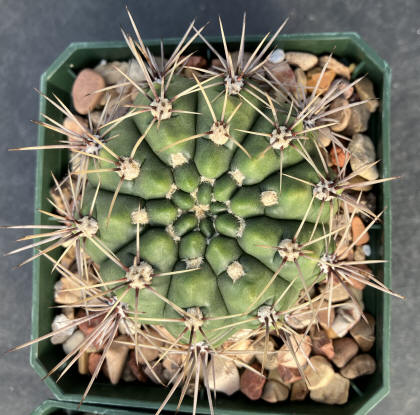 Gymnocalycium
neuhuberi lg - Makes offset with age. Bright pink flowers.
Argentina. Seed grown. Growing in 4 1/2" pots. 2 @ $15.00.
Gymnocalycium
neuhuberi lg - Makes offset with age. Bright pink flowers.
Argentina. Seed grown. Growing in 4 1/2" pots. 2 @ $15.00.
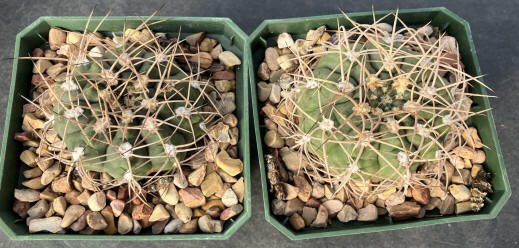
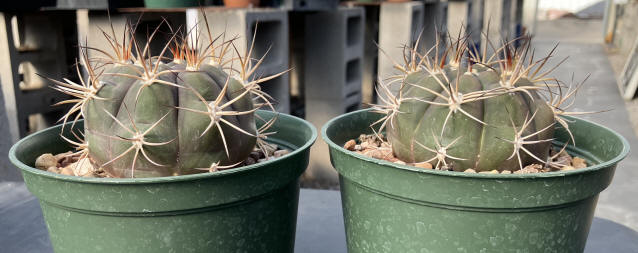
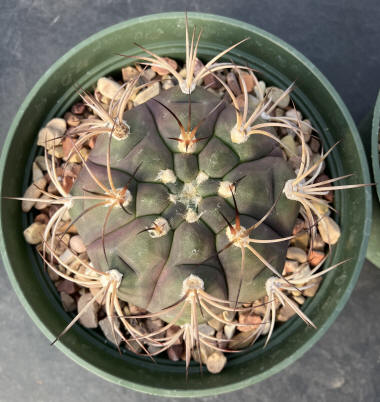 Gymnocalycium pflanzii ssp. albipulpa xlg -
This beauty has a purple tinged body and nice white flowers with a purple
throat. The characteristically purple hue of this specie varies during the year.
The bright coloring depends on sun exposure and is at its best (and showy) in
winter.
Bolivia. Seed grown. Growing in 6" pots. 1 in stock @ $20.00 each.
Gymnocalycium pflanzii ssp. albipulpa xlg -
This beauty has a purple tinged body and nice white flowers with a purple
throat. The characteristically purple hue of this specie varies during the year.
The bright coloring depends on sun exposure and is at its best (and showy) in
winter.
Bolivia. Seed grown. Growing in 6" pots. 1 in stock @ $20.00 each.
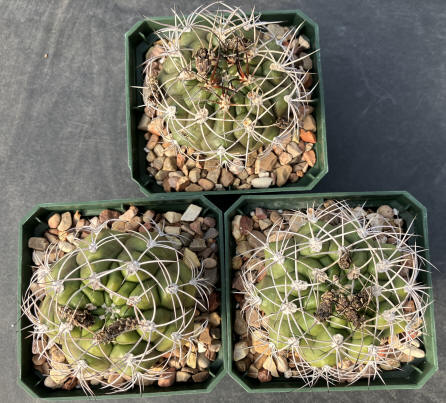 Gymnocalycium
pflanzii ssp. riograndense lg - Is
a single headed, flattened globular cactus, with peculiar spine clusters
characteristically bent backward in a distinctive fashion and with short tubed
flowers with bluish-red centers. This species is characterized by a marked
variability in the length and shape of the spines that resemble the long leg of
a spider and is hard to tell it apart from the other similar Gymnocalycium
pflanzii
forms and
varieties.
Bolivia. Seed grown. Growing in 4 1/2"
pots. 3 in stock @ $18.00 each.
Gymnocalycium
pflanzii ssp. riograndense lg - Is
a single headed, flattened globular cactus, with peculiar spine clusters
characteristically bent backward in a distinctive fashion and with short tubed
flowers with bluish-red centers. This species is characterized by a marked
variability in the length and shape of the spines that resemble the long leg of
a spider and is hard to tell it apart from the other similar Gymnocalycium
pflanzii
forms and
varieties.
Bolivia. Seed grown. Growing in 4 1/2"
pots. 3 in stock @ $18.00 each.
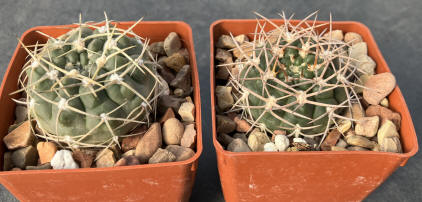 Gymnocalycium spegazzinii ssp. cardenasianum sm - The
seeds came with this name. Is
a solitary, slowly growing cactus, densely covered with incredibly strong
twisted spines pointing sideward and downward. Grey green, compact, globular (in
nature it is partially underground) with a slightly concave woolly apex. Flowers
are pinkish in color. They grow near the apex. The flowers of have
a tough time trying to force themselves through the fierce spines, and is quite
rare to see an open flower because the spines prevent the flowers from opening
properly. They will bloom at an early age and bloom sparingly in mid-summer.
Growing in 2.75" pots. 4 in
stock @ $15.00 each.
Gymnocalycium spegazzinii ssp. cardenasianum sm - The
seeds came with this name. Is
a solitary, slowly growing cactus, densely covered with incredibly strong
twisted spines pointing sideward and downward. Grey green, compact, globular (in
nature it is partially underground) with a slightly concave woolly apex. Flowers
are pinkish in color. They grow near the apex. The flowers of have
a tough time trying to force themselves through the fierce spines, and is quite
rare to see an open flower because the spines prevent the flowers from opening
properly. They will bloom at an early age and bloom sparingly in mid-summer.
Growing in 2.75" pots. 4 in
stock @ $15.00 each.
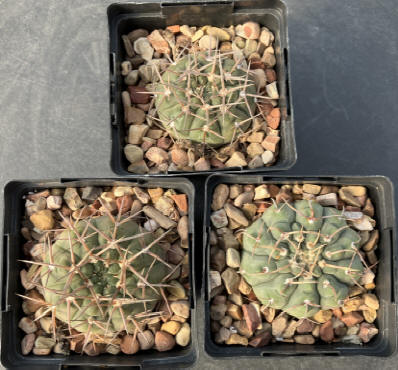 Gymnocalycium vatteri lg - Seed grown. May cluster with age. Whitish flowers
with reddish throats. Argentina. Growing in 4 1/2" pots. 1 @ $18.00 each.
Gymnocalycium vatteri lg - Seed grown. May cluster with age. Whitish flowers
with reddish throats. Argentina. Growing in 4 1/2" pots. 1 @ $18.00 each.