Home
We are not a
professional nor experts in Didiereaceae taxonomy. Any help with ID and spelling
are always welcome. To up-date pur list we've been using many books, journals, catalogs and other
web-sites. It's been helpful, but I have more work to do. We only ship to the
main 48 States and we can ship in the winter. I do offer 72+ hour heat packs for
$4.00 each.
Please read the front page for ordering information.
Didieraceae
 Allauadia
comasa lg -
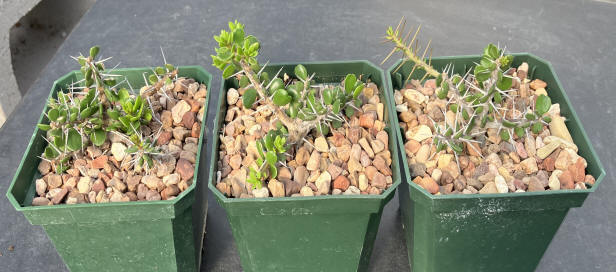
Is a densely spiny branching shrubs or small tree, with a short trunk, and the
branches stop at the top in a flat crown, often cushion-like. Thus, the whole
tree is shaped like a funnel or large mushroom. This characteristic silhouette
is easy to recognize even at a distance. Thick
stems.
Even the juvenile forms are profusely branched with small round flat leaves. have
extremely reduced inflorescences: only the terminal flower of a dichasium is
developed. This species is stem flowering and the flowers stand close together
on the stems, it is the only species to do so in the whole Family. Flowers are
white with stamens brilliant carmine-red. Madagascar. Rooted cuttings
from our old mother plant. Growing in 4 1/2" pots. 11 in stock @ $18.00 each.
Allauadia
comasa lg -
Is a densely spiny branching shrubs or small tree, with a short trunk, and the
branches stop at the top in a flat crown, often cushion-like. Thus, the whole
tree is shaped like a funnel or large mushroom. This characteristic silhouette
is easy to recognize even at a distance. Thick
stems.
Even the juvenile forms are profusely branched with small round flat leaves. have
extremely reduced inflorescences: only the terminal flower of a dichasium is
developed. This species is stem flowering and the flowers stand close together
on the stems, it is the only species to do so in the whole Family. Flowers are
white with stamens brilliant carmine-red. Madagascar. Rooted cuttings
from our old mother plant. Growing in 4 1/2" pots. 11 in stock @ $18.00 each.
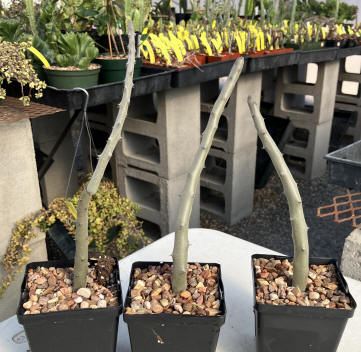
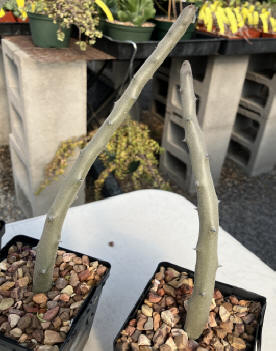 Allauadia dumosa m - Growing in 3 1/2" pots. 5 in
stock @ $15.00 each.
Allauadia dumosa m - Growing in 3 1/2" pots. 5 in
stock @ $15.00 each.
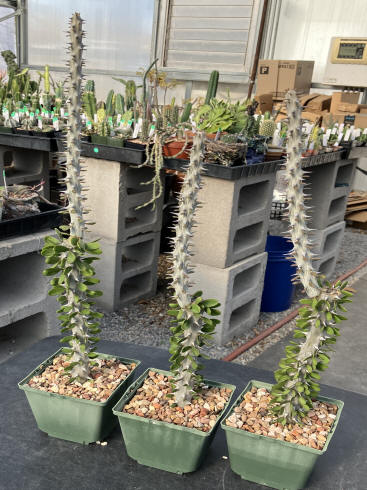
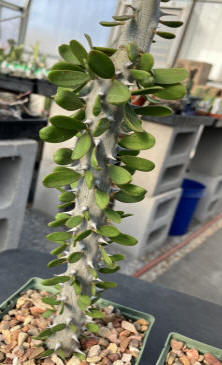 Allauadia procera lg -
Is
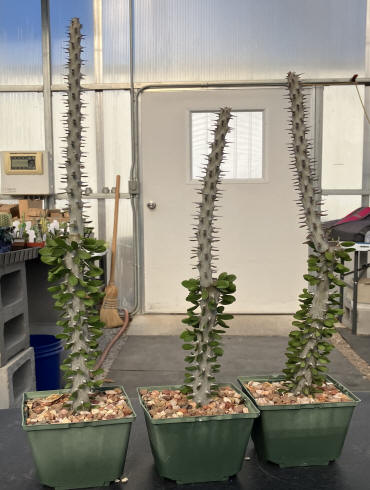
a spiny and scarcely branched or occasionally columnar, small succulent tree
with a very upright habit that looks a lot like a 'crown of thorns'. The plant
can grow rather tall, 1,5-3 m high indoors and up to 18 m tall in its native
haunts (but cultivated plant rarely surpass the 8 m of height). In its early
years this plant grows like a bush. Later its mature tree shape appears, this is
the only truly woody Didiereacea.
It can be identified at a distance by the spherical terminal inflorescences
balancing on the top of each branch.
Flowers are yellowish
white in crowded clusters at the end of the branches.
Alluaudia procera,
or Madagascar Ocotillo in many ways it resembles the American Ocotillo (Fouquieria
splendens)
with red flowers. Both have small rounded leaves and grayish trunks with a lot
of spines, but that is where the similarities and in fact they belongs to two
different families. This is a perfect example of convergent evolution -
unrelated plants adapting similar shapes and survival strategies in response to
the same environmental conditions. Will say a smaller in pot culture. These are
cuttings from our crested mother plants and may make crest. Growing in 4 1/2"
pots. 6 in stock @ $30.00 each.
Allauadia procera lg -
Is
a spiny and scarcely branched or occasionally columnar, small succulent tree
with a very upright habit that looks a lot like a 'crown of thorns'. The plant
can grow rather tall, 1,5-3 m high indoors and up to 18 m tall in its native
haunts (but cultivated plant rarely surpass the 8 m of height). In its early
years this plant grows like a bush. Later its mature tree shape appears, this is
the only truly woody Didiereacea.
It can be identified at a distance by the spherical terminal inflorescences
balancing on the top of each branch.
Flowers are yellowish
white in crowded clusters at the end of the branches.
Alluaudia procera,
or Madagascar Ocotillo in many ways it resembles the American Ocotillo (Fouquieria
splendens)
with red flowers. Both have small rounded leaves and grayish trunks with a lot
of spines, but that is where the similarities and in fact they belongs to two
different families. This is a perfect example of convergent evolution -
unrelated plants adapting similar shapes and survival strategies in response to
the same environmental conditions. Will say a smaller in pot culture. These are
cuttings from our crested mother plants and may make crest. Growing in 4 1/2"
pots. 6 in stock @ $30.00 each.
Home