Home
I am not a professional nor an expert in Cactacea or
Astrophytum taxonomy. Any help with ID and spelling are always welcome. To
up-date my list I've been using many books, journals, catalogs and other
web-sites. It's been helpful, but I have more work to do. We only ship to the
main 48 States. We are offering 72+ hour heat packs for $4.00 each.
Please read the front page for ordering information.
.
Note:
Photos were taking January 2025.
Astrophytum
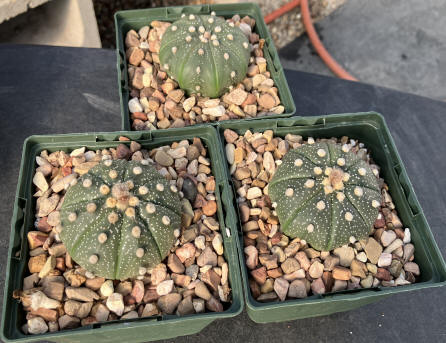 Astrophytum asterias
lg - Is
an extremely flat barrel cactus with unique and remarkably beautiful form and no
typical covering of spines, but with tiny speckled tuft of hairs less than
pinhead-sized. It produces large yellow flowers with orange throats often larger
than the plant itself. The common name comes of Sea-Urchin Cactus or Sand Dollar
resemblance to sea urchin without spines. Mexico.
Seed grown in the USA. Growing in
4 1/2" pots. 6 in stock @ $38.00 each.
Astrophytum asterias
lg - Is
an extremely flat barrel cactus with unique and remarkably beautiful form and no
typical covering of spines, but with tiny speckled tuft of hairs less than
pinhead-sized. It produces large yellow flowers with orange throats often larger
than the plant itself. The common name comes of Sea-Urchin Cactus or Sand Dollar
resemblance to sea urchin without spines. Mexico.
Seed grown in the USA. Growing in
4 1/2" pots. 6 in stock @ $38.00 each.
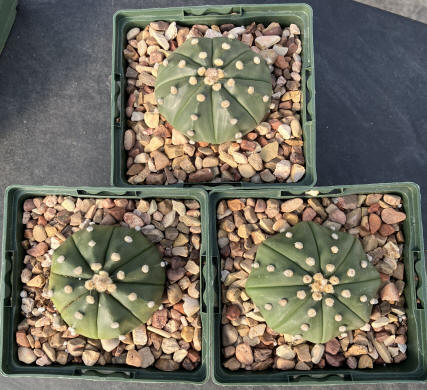 Astrophytum asterisa 'Nudum'
lg - This
form has a very characteristic glabrous stem lacking the white tufts of loose
hairy scales typical of the common Astrophytum
asterias.
The smooth green epidermis show up the felty areoles.
Nude plants are occasionally found in the natural habitat but many of the clones
actually in cultivation are of nursery origin.
Seed grown in the USA.
Growing in 2.75" pots. 6 in stock @ $38.00 each.
Astrophytum asterisa 'Nudum'
lg - This
form has a very characteristic glabrous stem lacking the white tufts of loose
hairy scales typical of the common Astrophytum
asterias.
The smooth green epidermis show up the felty areoles.
Nude plants are occasionally found in the natural habitat but many of the clones
actually in cultivation are of nursery origin.
Seed grown in the USA.
Growing in 2.75" pots. 6 in stock @ $38.00 each.
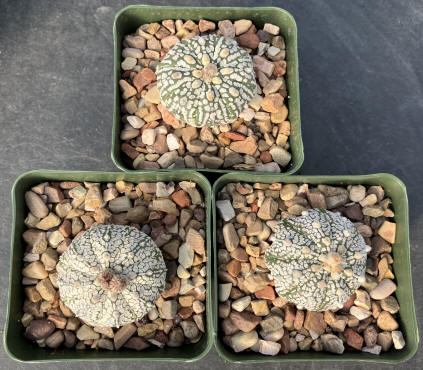 Astrophytum asterisa 'Superkabuto'
m -
'Super Kabuto' with
its inimitable fuzzy epidermis is actually the most popular cactus cultivar. It
is easily distinguished from the normal Astrophytum
asterias by
the epidermis, that does not have simple dots, but a mosaic of extensive white
spots that make the plant look intensely maculate. The "Superkabuto" would
(probably) come from a mutation that occurred in nature to just one
field-collected individual A.
asterias found
in 1981 by the Japanese Mr. Masaomi Takeo in an American garden centre and sold
to Tony Sato at a high price in Japan. Propagations have been made possible by
cross-pollinating this fist plant with other normal A.
asterias and Astrophytum
capricorne
(and possible other Astrophytum species
too), it can be concluded that all the SK actually available are the result of
intraspecific hybridization and SK contains not only A.
asterias genes
but also a significant number of A.
capricorne genes,
and maybe others. As a result spiny clones appear rather often and the name Astrophytum
asterias cv.
Super Kabuto is
not quite correct. Many different beautiful forms of 'Super
Kabuto' ,
which differ for the diverse pattern of the spots are now available. It would be
difficult to mention them all: they range from completely white forms ('white-type'),
to forms with woolly spots ('snow-type'),
to forms with a maculation like the shape of fly's wings ('zebra-type'
or 'V type').
Nursery
origin. Seed grown in the USA. Growing in 3 1/2" pots. 10 in stock @ $30.00 each.
Astrophytum asterisa 'Superkabuto'
m -
'Super Kabuto' with
its inimitable fuzzy epidermis is actually the most popular cactus cultivar. It
is easily distinguished from the normal Astrophytum
asterias by
the epidermis, that does not have simple dots, but a mosaic of extensive white
spots that make the plant look intensely maculate. The "Superkabuto" would
(probably) come from a mutation that occurred in nature to just one
field-collected individual A.
asterias found
in 1981 by the Japanese Mr. Masaomi Takeo in an American garden centre and sold
to Tony Sato at a high price in Japan. Propagations have been made possible by
cross-pollinating this fist plant with other normal A.
asterias and Astrophytum
capricorne
(and possible other Astrophytum species
too), it can be concluded that all the SK actually available are the result of
intraspecific hybridization and SK contains not only A.
asterias genes
but also a significant number of A.
capricorne genes,
and maybe others. As a result spiny clones appear rather often and the name Astrophytum
asterias cv.
Super Kabuto is
not quite correct. Many different beautiful forms of 'Super
Kabuto' ,
which differ for the diverse pattern of the spots are now available. It would be
difficult to mention them all: they range from completely white forms ('white-type'),
to forms with woolly spots ('snow-type'),
to forms with a maculation like the shape of fly's wings ('zebra-type'
or 'V type').
Nursery
origin. Seed grown in the USA. Growing in 3 1/2" pots. 10 in stock @ $30.00 each.
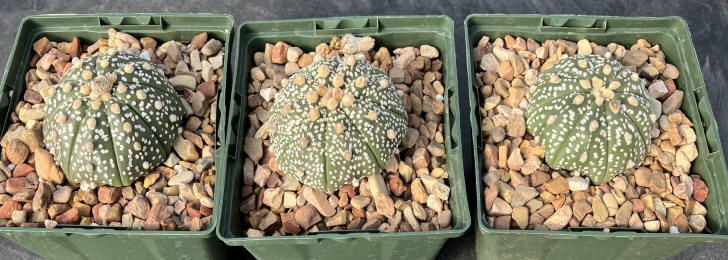 Astrophytum asterisa 'Superkabuto'
lg -
'Super Kabuto' with
its inimitable fuzzy epidermis is actually the most popular cactus cultivar. It
is easily distinguished from the normal Astrophytum
asterias by
the epidermis, that does not have simple dots, but a mosaic of extensive white
spots that make the plant look intensely maculate. The "Superkabuto" would
(probably) come from a mutation that occurred in nature to just one
field-collected individual A.
asterias found
in 1981 by the Japanese Mr. Masaomi Takeo in an American garden centre and sold
to Tony Sato at a high price in Japan. Propagations have been made possible by
cross-pollinating this fist plant with other normal A.
asterias and Astrophytum
capricorne
(and possible other Astrophytum species
too), it can be concluded that all the SK actually available are the result of
intraspecific hybridization and SK contains not only A.
asterias genes
but also a significant number of A.
capricorne genes,
and maybe others. As a result spiny clones appear rather often and the name Astrophytum
asterias cv.
Super Kabuto is
not quite correct. Many different beautiful forms of 'Super
Kabuto' ,
which differ for the diverse pattern of the spots are now available. It would be
difficult to mention them all: they range from completely white forms ('white-type'),
to forms with woolly spots ('snow-type'),
to forms with a maculation like the shape of fly's wings ('zebra-type'
or 'V type').
Nursery
origin. Seed grown in the USA. Growing in 4 1/2" pots. 15 in stock @ $48.00 each.
Astrophytum asterisa 'Superkabuto'
lg -
'Super Kabuto' with
its inimitable fuzzy epidermis is actually the most popular cactus cultivar. It
is easily distinguished from the normal Astrophytum
asterias by
the epidermis, that does not have simple dots, but a mosaic of extensive white
spots that make the plant look intensely maculate. The "Superkabuto" would
(probably) come from a mutation that occurred in nature to just one
field-collected individual A.
asterias found
in 1981 by the Japanese Mr. Masaomi Takeo in an American garden centre and sold
to Tony Sato at a high price in Japan. Propagations have been made possible by
cross-pollinating this fist plant with other normal A.
asterias and Astrophytum
capricorne
(and possible other Astrophytum species
too), it can be concluded that all the SK actually available are the result of
intraspecific hybridization and SK contains not only A.
asterias genes
but also a significant number of A.
capricorne genes,
and maybe others. As a result spiny clones appear rather often and the name Astrophytum
asterias cv.
Super Kabuto is
not quite correct. Many different beautiful forms of 'Super
Kabuto' ,
which differ for the diverse pattern of the spots are now available. It would be
difficult to mention them all: they range from completely white forms ('white-type'),
to forms with woolly spots ('snow-type'),
to forms with a maculation like the shape of fly's wings ('zebra-type'
or 'V type').
Nursery
origin. Seed grown in the USA. Growing in 4 1/2" pots. 15 in stock @ $48.00 each.

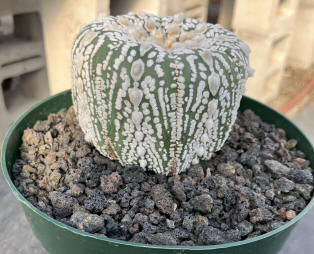 Astrophytum asterias "Super Kabuto" xlg No. 1 -
Nursery origin. Seed
grown in the USA. Growing in 6" pot. No. 1 @ $85.00.
Astrophytum asterias "Super Kabuto" xlg No. 1 -
Nursery origin. Seed
grown in the USA. Growing in 6" pot. No. 1 @ $85.00.
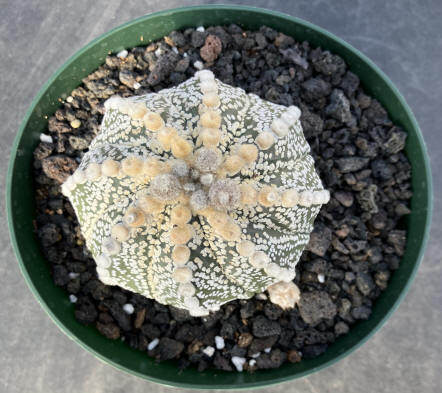
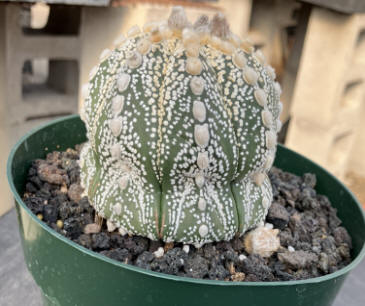 Astrophytum asterias
"Super Kabuto" xlg No. 2 - Nursery origin. Seed
grown in the USA. Growing in 6" pot. No. 2 @ $80.00.
Astrophytum asterias
"Super Kabuto" xlg No. 2 - Nursery origin. Seed
grown in the USA. Growing in 6" pot. No. 2 @ $80.00.
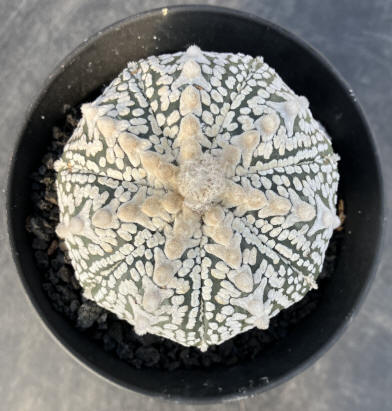
 Astrophytum asterias
"Super Kabuto V-Type" lg No. 3 - Nursery origin. Seed grown in the
USA. Growing in 4 1/2" pot. No. 3 @ $65.00.
Astrophytum asterias
"Super Kabuto V-Type" lg No. 3 - Nursery origin. Seed grown in the
USA. Growing in 4 1/2" pot. No. 3 @ $65.00.
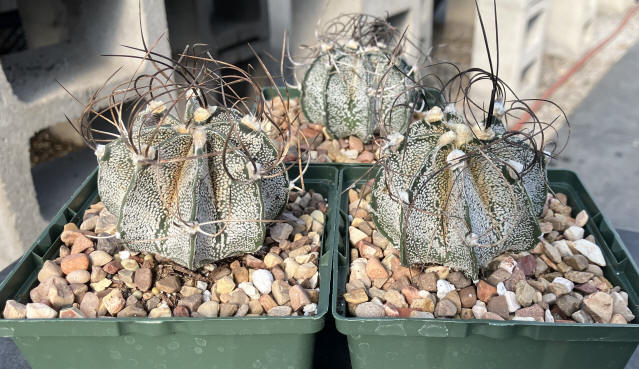 Astrophytum capricorne lg -
Solitary globose or columnar cactus.
Although young plants are globular, they soon become ovoid, and eventually
columnar up to 1.2 m tall, 10 (15) cm in diameter. The epidermis of is more or
less covered with the typical white woolly flecks characteristic of the genus.
Flowers are sweet
smelling large yellow with a red center. Northern Mexico. Seed
grown in the USA. Growing in 3 1/2"
pots. 17 in stock @ $18.00 each.
Astrophytum capricorne lg -
Solitary globose or columnar cactus.
Although young plants are globular, they soon become ovoid, and eventually
columnar up to 1.2 m tall, 10 (15) cm in diameter. The epidermis of is more or
less covered with the typical white woolly flecks characteristic of the genus.
Flowers are sweet
smelling large yellow with a red center. Northern Mexico. Seed
grown in the USA. Growing in 3 1/2"
pots. 17 in stock @ $18.00 each.
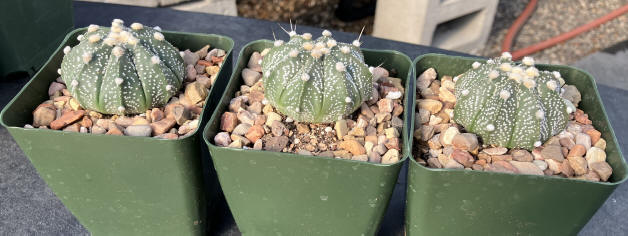 Astrophytum capricorne x asterias m -
Garden origin (Nursery produced cultivar) A nice plant obtained by controlled
pollination of ♀ Astrophytum
capricorne x
♂ Astrophytum
asterias.
Compare with the inverse hybrid Astrophytum
hybrid AS-CAP (A. asterias x A. capricorne which
is similar but with (usually) shorter spines.
Nursery origin. Seed grown in the USA. Growing in 3
1/2" pots. 5 in stock @ $28.00 each.
Astrophytum capricorne x asterias m -
Garden origin (Nursery produced cultivar) A nice plant obtained by controlled
pollination of ♀ Astrophytum
capricorne x
♂ Astrophytum
asterias.
Compare with the inverse hybrid Astrophytum
hybrid AS-CAP (A. asterias x A. capricorne which
is similar but with (usually) shorter spines.
Nursery origin. Seed grown in the USA. Growing in 3
1/2" pots. 5 in stock @ $28.00 each.
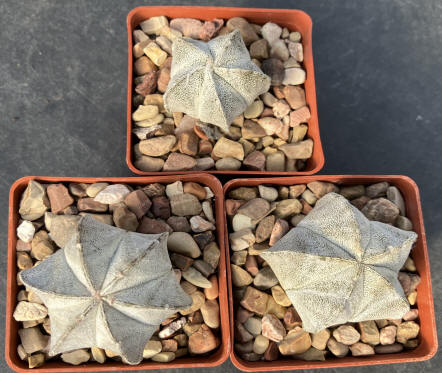 Astrophytum coahuilense sm -
Has five ribs, has a surprising similarity to Astrophytum
myriostigma.
However, it is different in all characteristics regarding flower, fruit, seed
and embryo which looks like in all details to Astrophytum
capricorne.
The differences into flower, fruit, seed and embryo and flecks are constant and
permit in any case to distinguish A.
coahuilense without
problems from A.
myriostigma.
The flowers are yellow with a characteristic red throat, although can appear
pure red or very seldom pure yellow. In the fruit which is red till olive-green
coloured and basal opening are up to 200 seeds, similar as in the case of
Astrophytum capricorne. This plant is more related to the Asterias/capricorne group than the myriostigma.
A. coahuilense and A.
myriostigma when
cross-pollinated are fruitless: they are (usually) sterile by each other.
Mexico. Seed grown in the USA.
Growing in 2.75" pots. 6 in stock @ $18.00 each.
Astrophytum coahuilense sm -
Has five ribs, has a surprising similarity to Astrophytum
myriostigma.
However, it is different in all characteristics regarding flower, fruit, seed
and embryo which looks like in all details to Astrophytum
capricorne.
The differences into flower, fruit, seed and embryo and flecks are constant and
permit in any case to distinguish A.
coahuilense without
problems from A.
myriostigma.
The flowers are yellow with a characteristic red throat, although can appear
pure red or very seldom pure yellow. In the fruit which is red till olive-green
coloured and basal opening are up to 200 seeds, similar as in the case of
Astrophytum capricorne. This plant is more related to the Asterias/capricorne group than the myriostigma.
A. coahuilense and A.
myriostigma when
cross-pollinated are fruitless: they are (usually) sterile by each other.
Mexico. Seed grown in the USA.
Growing in 2.75" pots. 6 in stock @ $18.00 each.
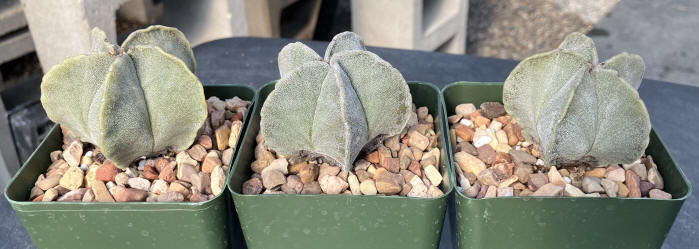 Astrophytum myriostrgma
m -
Is
a spineless succulent plant, usually solitary or with very few basal branches. A
transverse section of the stem reveal a perfect star shaped form (like the
common star-fish) giving the plant the appearance of a common name Bishop's cap. Globular to cylindrical, bright green, covered with
many minute white hairy scales that give it a characteristic chalk-white or
silvery-grey appearance, but sometime naked. The scales are composed of very
fine interwoven hairs, which, under a microscope, are very pretty object.
Flowers are funnel
form, glossy yellow and sweet scented from the areole at the tip of the stem on
mature plant. Mexico. Seed grown in the USA. Growing in 3 1/2"
pot. 12 in stock @ $15.00 each.
Astrophytum myriostrgma
m -
Is
a spineless succulent plant, usually solitary or with very few basal branches. A
transverse section of the stem reveal a perfect star shaped form (like the
common star-fish) giving the plant the appearance of a common name Bishop's cap. Globular to cylindrical, bright green, covered with
many minute white hairy scales that give it a characteristic chalk-white or
silvery-grey appearance, but sometime naked. The scales are composed of very
fine interwoven hairs, which, under a microscope, are very pretty object.
Flowers are funnel
form, glossy yellow and sweet scented from the areole at the tip of the stem on
mature plant. Mexico. Seed grown in the USA. Growing in 3 1/2"
pot. 12 in stock @ $15.00 each.
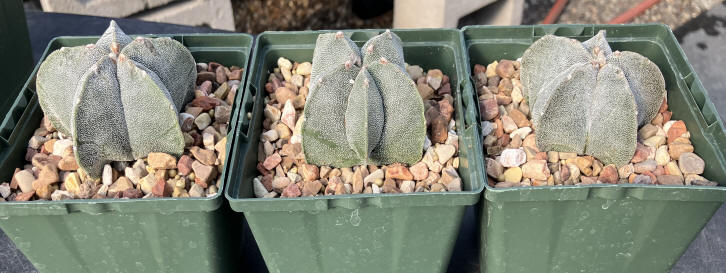 Astrophytum myriostrgma lg -
Is
a spineless succulent plant, usually solitary or with very few basal branches. A
transverse section of the stem reveal a perfect star shaped form (like the
common star-fish) giving the plant the appearance of a common name Bishop's cap. Globular to cylindrical, bright green, covered with
many minute white hairy scales that give it a characteristic chalk-white or
silvery-grey appearance, but sometime naked. The scales are composed of very
fine interwoven hairs, which, under a microscope, are very pretty object.
Flowers are funnel
form, glossy yellow and sweet scented from the areole at the tip of the stem on
mature plant. Mexico. Seed grown in the USA. Growing in 4 1/2" pot. 7 in stock @ $18.00 each.
Astrophytum myriostrgma lg -
Is
a spineless succulent plant, usually solitary or with very few basal branches. A
transverse section of the stem reveal a perfect star shaped form (like the
common star-fish) giving the plant the appearance of a common name Bishop's cap. Globular to cylindrical, bright green, covered with
many minute white hairy scales that give it a characteristic chalk-white or
silvery-grey appearance, but sometime naked. The scales are composed of very
fine interwoven hairs, which, under a microscope, are very pretty object.
Flowers are funnel
form, glossy yellow and sweet scented from the areole at the tip of the stem on
mature plant. Mexico. Seed grown in the USA. Growing in 4 1/2" pot. 7 in stock @ $18.00 each.
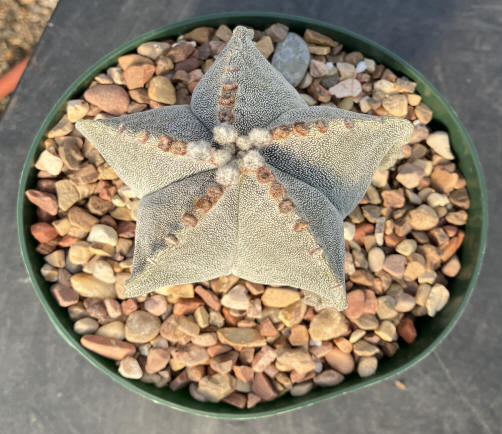 Astrophytum myriostigma MG8084 xlg -
Seed grown in the USA. Mexico. Growing in 6" pot. 1
in stock @ $50.00.
Astrophytum myriostigma MG8084 xlg -
Seed grown in the USA. Mexico. Growing in 6" pot. 1
in stock @ $50.00.
 Astrophytum myriostigma MG8093
xlg - Seed grown in the USA. Mexico. Growing in 6" pot. 1 in stock @ $50.00.
Astrophytum myriostigma MG8093
xlg - Seed grown in the USA. Mexico. Growing in 6" pot. 1 in stock @ $50.00.
 Astrophytum myriostigma MG8096 xlg -
Seed grown in the USA. Mexico. Growing in 6" pot. 1
in stock @ $50.00.
Astrophytum myriostigma MG8096 xlg -
Seed grown in the USA. Mexico. Growing in 6" pot. 1
in stock @ $50.00.
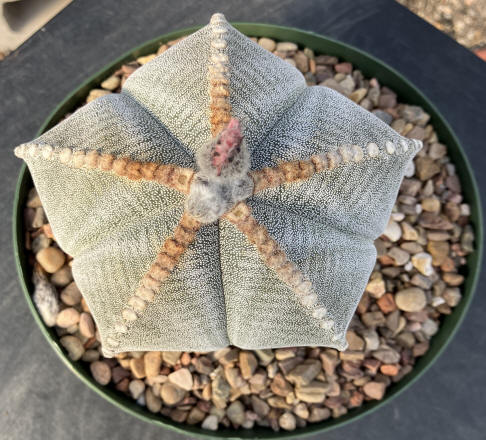 Astrophytum myriostigma ssp. multicostatum xxlg -
Seed grown in the USA. Mexico. Growing in 8" pot. 1
in stock @ $80.00.
Astrophytum myriostigma ssp. multicostatum xxlg -
Seed grown in the USA. Mexico. Growing in 8" pot. 1
in stock @ $80.00.
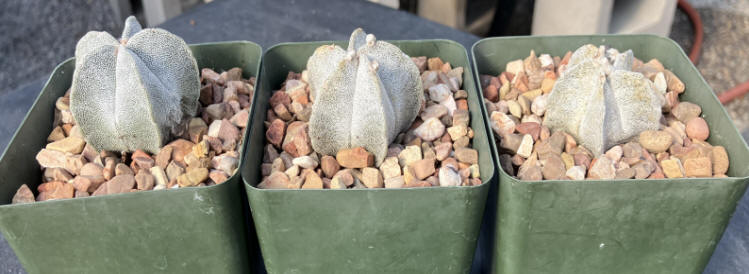 Astrophytum myriostigma ssp. columnare m -
This
questionable variety is very similar to the other myriostigmas, it only deviate
from the well-known typical form for its more columnar growth and smaller
flowers size. Stem are slender and more thin, already in the youth phase.
Dimension 25-50(-100) cm tall, only 5-8 cm in diameter shaped like a bishop's
headpiece or a star.
Astrophytum myriostigma ssp. columnare m -
This
questionable variety is very similar to the other myriostigmas, it only deviate
from the well-known typical form for its more columnar growth and smaller
flowers size. Stem are slender and more thin, already in the youth phase.
Dimension 25-50(-100) cm tall, only 5-8 cm in diameter shaped like a bishop's
headpiece or a star.
Flowers are smaller than those of A.
myriostigma,
hardly 2,5 cm in length, pale-yellow, silk-shining, occasionally with an orange
gloom. Mexico. Seed grown in the USA. Growing in
3 1/2" pots. 9 in stock @ $20.00 each.
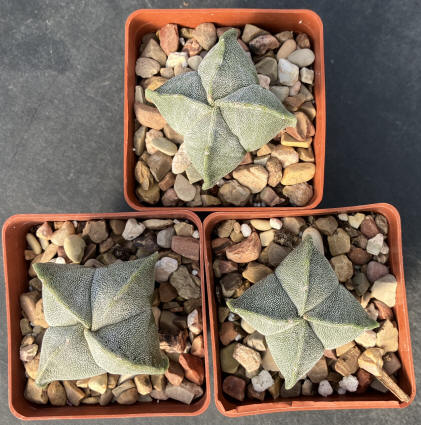 Astrophytum myriostigma ssp. quadricostatum sm -
Was first described in 1841 by M. Mittler who wrote "The body of the plant is of
elongated round form and has four ribs". This form deviates from the well-known
typical form for having four ribs instead of five. Stem are
quadrangular to almost spherical, the plants become shortly columnar with age.
The stems are smooth and can be over 90 cm tall and 5-10 (-20) cm in diameter.
Astrophytum myriostigma ssp. quadricostatum sm -
Was first described in 1841 by M. Mittler who wrote "The body of the plant is of
elongated round form and has four ribs". This form deviates from the well-known
typical form for having four ribs instead of five. Stem are
quadrangular to almost spherical, the plants become shortly columnar with age.
The stems are smooth and can be over 90 cm tall and 5-10 (-20) cm in diameter.
No spines. Flowers arise
from the areole at the tip of the stem on mature plant. up to 5 cm wide (or
more), pale-yellow, shining-silk, unlike the 5-ribbed plant. Blooming
season is spring or late summer when the plants get larger. Mexico. Seed grown in the
USA. Growing in 2.75" pots. 3 in stock @ $15.00 each.
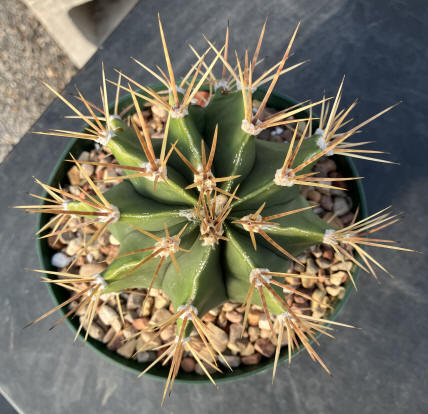
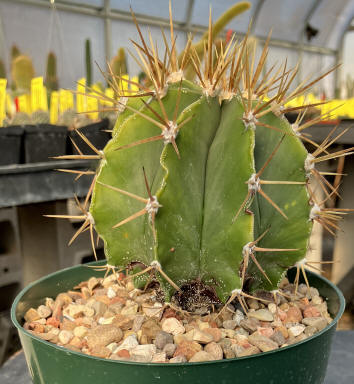 Astrophytum ornatum SB127 MG No. 1 -
Seed grown in the USA. Mexico. Growing in 6" pot. 1 in stock @ $35.00.
Astrophytum ornatum SB127 MG No. 1 -
Seed grown in the USA. Mexico. Growing in 6" pot. 1 in stock @ $35.00.
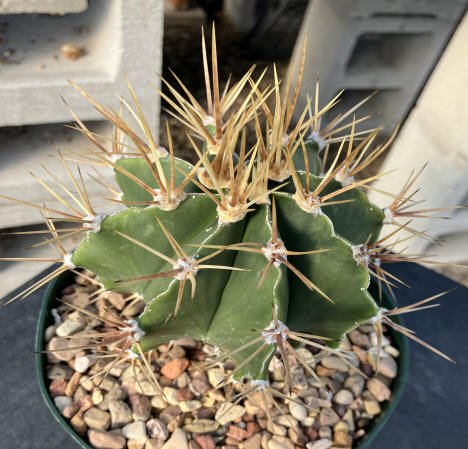
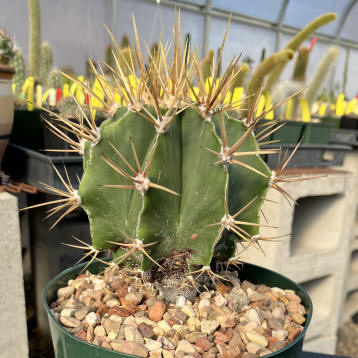 Astrophytum ornatum SB127 MG No. 2 -
Seed grown in the USA. Mexico. Growing in 6" pot. 1 in stock @ $35.00.
Astrophytum ornatum SB127 MG No. 2 -
Seed grown in the USA. Mexico. Growing in 6" pot. 1 in stock @ $35.00.
Home